
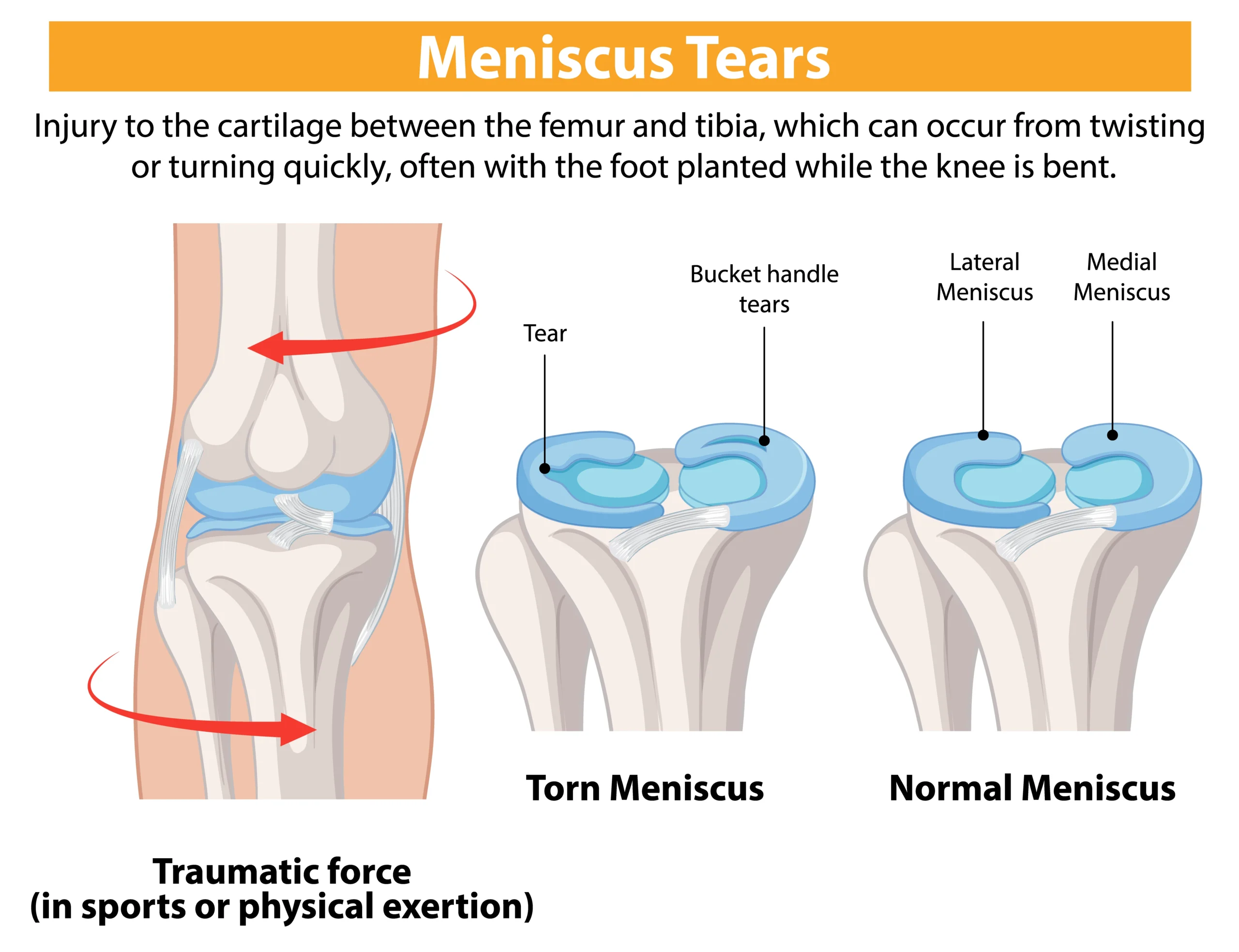
What Is the Meniscus?
The knee contains two C-shaped wedges of fibrocartilage — the medial meniscus (inner side) and the lateral meniscus (outer side). These act as shock absorbers, distribute load across the joint, and help stabilise the knee. When torn, they can no longer perform these functions effectively, leading to pain, mechanical symptoms, and — over time — accelerated cartilage wear. For a broader understanding of how this fits into types of knee pain, see our earlier guide.Types of Meniscus Tears
Not all meniscus tears are the same. The type of tear affects both the symptoms and the treatment approach.| Type of Tear | Description | Common in |
| Radial tear | Cuts across the width of the meniscus; most common type | Young adults, sports injuries |
| Horizontal tear | Splits the meniscus along its length into upper and lower halves | Middle-aged adults, degenerative |
| Bucket-handle tear | Large, displaced tear that can cause the knee to lock | Young athletes, acute trauma |
| Flap tear | A flap of meniscal tissue folds over and catches in the joint | Mixed age group |
| Degenerative tear | Gradual fraying and breakdown without a single traumatic event | Adults over 45, OA-related |
| Complex tear | Involves multiple patterns; most difficult to repair | Older adults, longstanding OA |
What Causes a Meniscus Tear?
Traumatic Tears (Acute)
Acute meniscus tears result from a sudden, forceful event and are common in younger, active individuals:- Twisting or pivoting on a bent, weight-bearing knee
- Deep squatting or sudden deceleration
- Direct contact or collision — common in football, cricket, kabaddi, and wrestling
- Often associated with ACL injury — see our guide on ACL injury symptoms and treatment
Degenerative Tears (Chronic)
In adults over 40, meniscus tears can develop gradually without any specific injury. The cartilage weakens over time due to:- Age-related wear and reduced tissue elasticity
- Pre-existing knee osteoarthritis — the meniscus degenerates alongside the articular cartilage
- Repetitive occupational loading — prolonged squatting, kneeling, or heavy lifting
Meniscus Tear Symptoms: What to Look For
Symptoms vary depending on the type, size, and location of the tear:- Joint line pain: Tenderness along the inner (medial) or outer (lateral) edge of the knee — the most consistent finding
- Swelling: Develops gradually over 24–48 hours after an acute injury; may be mild in degenerative tears
- Stiffness: Difficulty fully bending or straightening the knee, especially in the morning
- Clicking or catching: A mechanical sensation during knee movement as the torn fragment catches in the joint
- Locking: The knee becomes stuck in a bent position and cannot be straightened — classic of a bucket-handle tear
- Giving way: A sensation of instability, particularly on stairs or uneven ground
How Is a Meniscus Tear Diagnosed?
- Clinical examination: McMurray test, Thessaly test, and joint line tenderness assessment — reliable in experienced hands
- X-ray: Rules out bony injury and assesses for co-existing osteoarthritis
- MRI: Gold standard — confirms the diagnosis, identifies tear type, pattern, and any concurrent ligament or cartilage damage
Meniscus Tear Treatment Options
Non-Surgical Treatment
Small, stable tears — especially in the outer vascular zone where blood supply supports healing — can often be managed without surgery:- Rest, ice, compression, and elevation (PRICE protocol) in the acute phase
- Anti-inflammatory medications to reduce pain and swelling
- Physiotherapy to restore range of motion and strengthen surrounding muscles
- Activity modification — avoiding deep squats, pivoting, and high-impact activities
Surgical Treatment — Knee Arthroscopy
When the tear causes locking, persistent mechanical symptoms, or fails to respond to conservative care, knee arthroscopy is the recommended treatment. It is a minimally invasive procedure performed through two small keyhole incisions under arthroscopic guidance. Two main surgical options are available:- Meniscus repair: The torn edges are sutured back together. Preferred when the tear is in the vascular zone and the patient is young — preserves meniscal tissue and protects long-term joint health. Recovery: 3–4 months
- Partial meniscectomy: The damaged portion of the meniscus is trimmed and removed. Used for irreparable tears in the avascular zone. Faster recovery: 4–6 weeks to normal activity
Meniscus Tear Recovery Time
| Treatment | Return to Daily Activity | Return to Sport |
| Non-surgical (physiotherapy) | 4–8 weeks | 3–4 months (depending on sport) |
| Partial meniscectomy | 4–6 weeks | 6–8 weeks (non-contact sport) |
| Meniscus repair | 6–8 weeks | 3–4 months (protected return) |
Frequently Asked Questions
Q1. Can a meniscus tear heal without surgery?
Small tears in the outer vascular zone can heal with rest and physiotherapy. Larger, complex, or inner-zone tears — and those causing locking — generally require surgery.Q2. What does a meniscus tear feel like?
Localised pain along the inner or outer knee joint line, swelling within 24–48 hours, and a clicking, catching, or locking sensation during movement are the most common feelings.Q3. How long does meniscus surgery recovery take?
Partial meniscectomy: 4–6 weeks to normal activity. Meniscus repair: 3–4 months due to the healing time required for the sutured tissue.Q4. Is meniscus surgery done arthroscopically?
Yes. At Happy Knees, all meniscal procedures are performed arthroscopically through small keyhole incisions — minimising tissue disruption and allowing a faster recovery than open surgery.Q5. Can a meniscus tear lead to arthritis?
Yes. Untreated or irreparable tears reduce the knee's shock-absorbing capacity, increasing cartilage stress and accelerating the development of osteoarthritis over time. Early treatment is important.Q6. Do I need an MRI to diagnose a meniscus tear?
An experienced clinician can often diagnose a meniscus tear clinically, but MRI is essential to confirm the type, size, and location — particularly before planning surgery.Why Choose Us?
At Happy Knees Orthopaedic Clinic, we provide expert, compassionate care to help you move pain-free and improve your quality of life. Specializing in knee and joint treatments, we combine advanced technology with experienced orthopedic expertise to deliver accurate diagnosis and personalized treatment plans. With a strong focus on patient comfort, clear communication, and evidence-based care in a professional, welcoming environment, your joint health is always our priority. To book a consultation, contact 08341535353 or visit https://happyknees.in/References & Citations
- AAOS. Meniscus Tears — OrthoInfo. American Academy of Orthopaedic Surgeons. 2022.
- Mordecai SC, et al. Treatment of meniscal tears: an evidence-based approach. World J Orthop. 2014;5(3):233–241.
- Beaufils P, et al. Clinical practice guidelines for the management of meniscal lesions. Orthop Traumatol Surg Res. 2016;102(8):1065–1075.
- Sihvonen R, et al. Arthroscopic partial meniscectomy versus sham surgery for a degenerative meniscus tear. N Engl J Med. 2013;369:2515–2524.
- Lohmander LS, et al. The long-term consequence of anterior cruciate ligament and meniscus injuries. Am J Sports Med. 2007;35(10):1756–1769.