
What Is Golfer's Elbow?
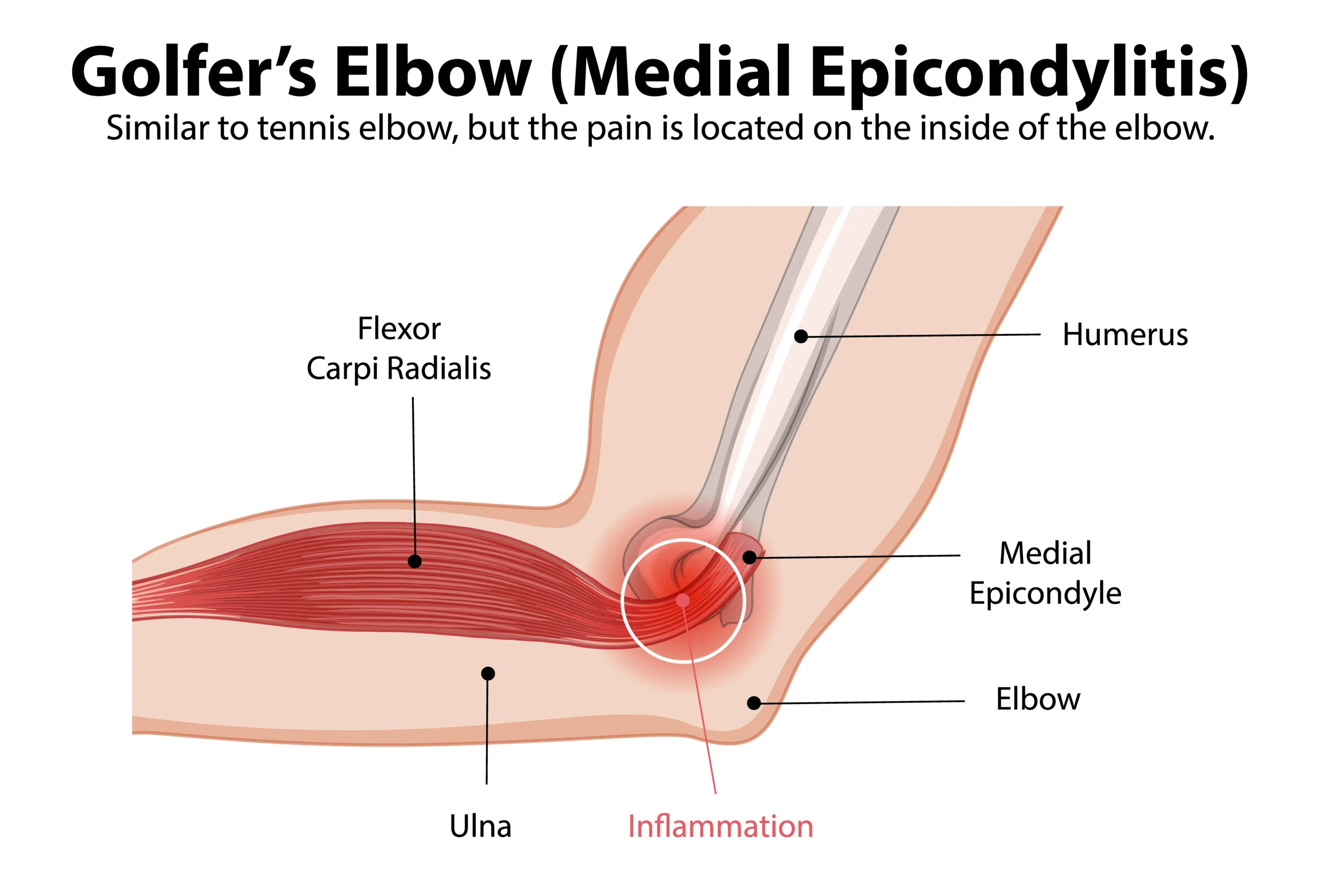
Golfer's elbow — medial epicondylitis — is a degenerative condition of the common flexor-pronator tendon at its attachment to the medial epicondyle (the bony prominence on the inner side of the elbow). Repetitive wrist flexion, forearm pronation, and gripping activities cause micro-tears and tendon degeneration — the same angiofibroblastic tendinosis process that underlies tennis elbow, but at a different anatomical site. Despite the name, fewer than 10% of cases occur in golfers. The majority affect manual workers, throwing athletes, and — increasingly — office workers and gamers with sustained wrist and grip loading. It is less common than tennis elbow, occurring at roughly a 1:7 ratio.Golfer's Elbow vs Tennis Elbow: Side-by-Side Comparison
The two conditions are mirror images of each other. Understanding the distinction prevents delayed diagnosis and misdirected treatment:|
Feature |
Golfer's Elbow | Tennis Elbow |
| Medical name | Medial epicondylitis |
Lateral epicondylitis |
|
Pain location |
Inner (medial) side of the elbow | Outer (lateral) side of the elbow |
| Tendon affected | Common flexor-pronator tendon |
Common extensor tendon (ECRB) |
|
Aggravating movements |
Wrist flexion, gripping, forearm pronation |
Wrist extension, gripping, lifting |
|
Nerve involvement |
Ulnar nerve (tingling in ring/little finger) |
Radial nerve (rare) |
|
Common in |
Golfers, throwers, manual workers, gamers | Racquet sports, office workers, tradespeople |
| Relative frequency | Less common (~1 in 8 elbow tendinopathies) |
More common (~7 in 8) |
|
ICD-10 code |
M77.0 |
M77.1 |
What Causes Golfer's Elbow?
The root cause is repetitive overloading of the flexor-pronator tendon — activities that repeatedly flex the wrist or pronate the forearm against resistance. Common triggers include:- Golf: forceful wrist flexion at ball impact and follow-through — particularly with poor swing mechanics or gripping the club too tightly
- Throwing sports: cricket, baseball, javelin — the acceleration phase of throwing loads the medial elbow significantly
- Racquet sports: heavy topspin serves in tennis, badminton smashes — wrist flexion-dominated strokes
- Weightlifting: barbell curls, pull-ups, deadlifts — sustained gripping under load
- Occupational: carpenters, mechanics, plumbers — repetitive hammering, screwdriving, and pipe work
- Desk work and gaming: sustained mouse grip, keyboard use, and controller use with a pronated forearm position
Golfer's Elbow Symptoms
Symptoms develop gradually and worsen with continued loading. The key features that distinguish golfer's elbow from other causes of inner elbow pain:- Inner elbow pain and tenderness: localised to the medial epicondyle and the proximal forearm — tender to direct palpation
- Pain with wrist flexion against resistance: the most reliable clinical sign — reproduces pain at the medial epicondyle
- Weak grip strength: reduced grip force, particularly when the elbow is extended
- Pain radiating down the inner forearm: aching that extends toward the wrist along the flexor muscle belly
- Stiffness in the morning: particularly after periods of inactivity or sustained gripping the previous day
- Tingling in the ring and little fingers: due to proximity of the ulnar nerve to the medial epicondyle — a distinguishing feature not typically seen in tennis elbow
How Is Golfer's Elbow Diagnosed?
Diagnosis is primarily clinical, based on history and examination:- Medial epicondyle tenderness: direct palpation over the medial epicondyle and common flexor origin — present in virtually all cases
- Resisted wrist flexion test: patient flexes the wrist against resistance with the elbow extended — reproduction of medial elbow pain is diagnostic
- Resisted forearm pronation: similar reproduction of pain with resisted pronation
- Ultrasound: confirms tendon thickening, hypoechoic degeneration, and calcification; useful for guiding injections
- MRI: reserved for atypical presentations, suspected UCL injury, or surgical planning
Golfer's Elbow Treatment Options
Over 90% of golfer's elbow cases resolve with non-surgical management. Treatment follows the same stepwise approach as tennis elbow, with some technique-specific differences.1. Load Management and Activity Modification
Identify and reduce the provocative activity. Avoid complete rest — progressive graded loading is more effective for tendon recovery than immobilisation. Physiotherapy guidance on activity modification is essential from the outset.2. Physiotherapy and Exercise
The evidence base for golfer's elbow rehabilitation mirrors that for tennis elbow, with eccentric and isometric wrist flexion loading as the primary intervention:- Eccentric wrist flexion exercises: controlled lowering phase of wrist flexion with a light weight — the most evidence-supported exercise for flexor tendinopathy
- Isometric wrist flexion holds: sustained contraction without movement — effective for pain modulation in the early phase
- Forearm stretching: wrist extension stretch with elbow extended to lengthen the flexor-pronator group
- Grip strengthening: progressive loading of grip to restore functional strength — critical for return to sport and work
- Ulnar nerve mobilisation: neural gliding exercises if ulnar nerve symptoms are present
3. Bracing
A medial counterforce brace or elbow sleeve reduces tensile load through the flexor-pronator tendon during activity. It provides symptomatic relief and enables continued function during rehabilitation — but does not treat the underlying tendinopathy.4. Injection Therapies
- Corticosteroid injection: rapid short-term relief (4–8 weeks); high recurrence rate with repeated use; not recommended as first-line beyond one injection
- PRP (Platelet-Rich Plasma): superior long-term outcomes compared to corticosteroid beyond 3 months; preferred biological option at Happy Knees; particularly effective for chronic medial epicondylitis
- Autologous blood injection: cost-effective alternative with similar growth factor rationale
5. Shockwave Therapy
Extracorporeal shockwave therapy (ESWT) stimulates tendon healing through acoustic energy delivery. Effective for chronic golfer's elbow that has not responded to physiotherapy. Typically 3–5 sessions. Often used in combination with PRP for recalcitrant cases.6. Surgery
Surgical debridement is rarely required — fewer than 5% of cases. Considered only after 12+ months of failed conservative treatment. Open or arthroscopic release of the degenerate flexor-pronator origin provides good outcomes in carefully selected patients. Recovery: 3–6 months to full activity.Golfer's Elbow Recovery Timeline
|
Treatment |
Expected Response | Full Recovery |
| Activity modification + physiotherapy | 4–8 weeks |
3–6 months |
|
Corticosteroid injection |
1–2 weeks | 4–8 weeks (short-term; recurrence common) |
| PRP injection | 4–6 weeks |
6–12 months (sustained benefit) |
|
Shockwave therapy (3–5 sessions) |
4–8 weeks |
3–6 months |
|
Surgical debridement |
6–12 weeks |
3–6 months to full activity |
Can You Have Golfer's Elbow and Tennis Elbow at the Same Time?
Yes — though uncommon, bilateral tendinopathy (golfer's elbow on the inner side and tennis elbow on the outer side of the same elbow) can occur, particularly in manual workers or athletes with very high training loads. The management principles remain the same for each tendon, but a combined rehabilitation programme is needed. If you have been assessed for tennis elbow and still have unexplained inner elbow pain, golfer's elbow should be specifically assessed.Prevention: Reducing Your Risk
- Optimise technique in your sport or occupation — a coach or ergonomics review to identify loading errors
- Progressively increase training load — avoid sudden spikes in grip-intensive activity
- Maintain forearm and wrist flexibility with daily stretching
- Strengthen the flexor-pronator group progressively as part of any upper limb conditioning programme
- Support tendon health with anti-inflammatory nutrition — see our guide on nutrition for joint health
- Apply ice after activity that produces medial elbow discomfort — 15–20 minutes to limit reactive inflammation
Frequently Asked Questions
Q1. What is golfer's elbow?
Medial epicondylitis — a degenerative condition of the common flexor tendon at the inner elbow, caused by repetitive wrist flexion and gripping. Most cases occur in non-golfers.Q2. How is golfer's elbow different from tennis elbow?
Tennis elbow affects the outer elbow (lateral epicondyle) from wrist extension activities. Golfer's elbow affects the inner elbow (medial epicondyle) from wrist flexion and gripping. They are mirror-image tendinopathies.Q3. How long does golfer's elbow take to heal?
3–6 months with physiotherapy and load management. Chronic cases requiring PRP or shockwave therapy may take 6–12 months.Q4. Can golfer's elbow cause finger tingling?
Yes — the ulnar nerve runs close to the medial epicondyle and can be irritated, causing tingling or numbness in the ring and little fingers. If nerve symptoms are significant, ulnar nerve assessment is needed.Q5. Is PRP effective for golfer's elbow?
Yes. PRP delivers superior long-term outcomes compared to corticosteroid injection beyond 3 months, making it the preferred injection option for chronic medial epicondylitis that has not responded to physiotherapy.Q6. Can I keep playing golf or sport with golfer's elbow?
Yes — with appropriate load modification, a brace, and physiotherapy guidance. Complete rest is not recommended. Technique correction is often as important as rest in preventing recurrence.Why Choose Us?
At Happy Knees Orthopaedic Clinic, we provide expert, compassionate care to help you move pain-free and improve your quality of life. Specializing in knee and joint treatments, we combine advanced technology with experienced orthopedic expertise to deliver accurate diagnosis and personalized treatment plans. With a strong focus on patient comfort, clear communication, and evidence-based care in a professional, welcoming environment, your joint health is always our priority. To book a consultation, contact 08341535353 or visit https://happyknees.in/References & Citations
- Coombes BK, et al. Efficacy and safety of corticosteroid injections and other injections for management of tendinopathy. Lancet. 2010;376(9754):1751–1767.
- Peerbooms JC, et al. Positive effect of an autologous platelet concentrate in lateral epicondylitis in a double-blind randomised controlled trial. Am J Sports Med. 2010;38(2):255–262.
- Sims SE, et al. Non-surgical treatment of lateral epicondylitis: a systematic review of randomised controlled trials. Hand (NY). 2014;9(4):419–446.
- Maffulli N, et al. Tennis elbow: current concepts. Br Med Bull. 2012;102(1):201–225.
- NICE. Golfer's elbow (medial epicondylitis) — overview. CKS Clinical Knowledge Summary. 2023.