
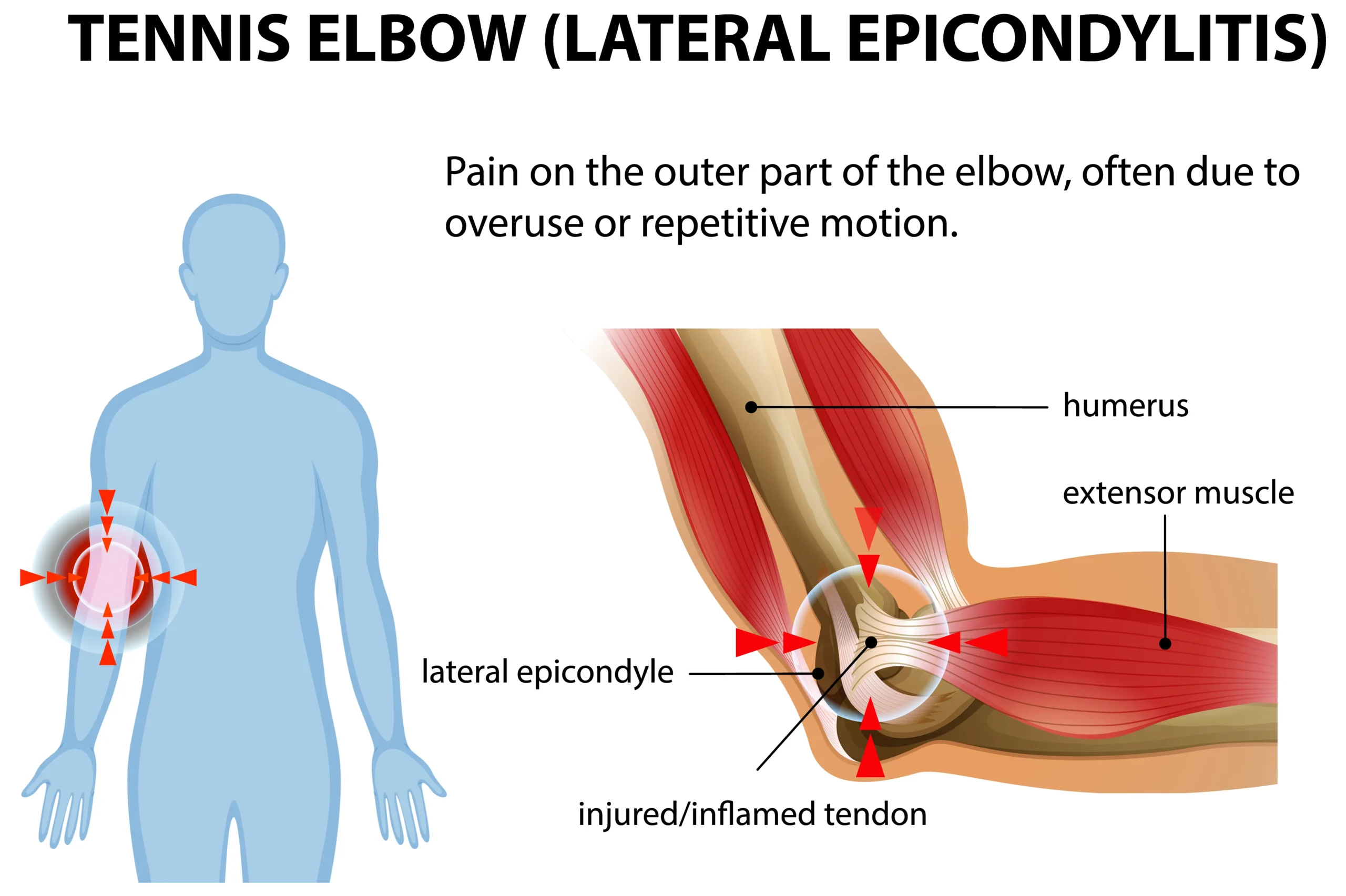
What Is Tennis Elbow?
Tennis elbow — medically known as lateral epicondylitis — is a condition involving degeneration and micro-tearing of the tendons that attach to the lateral epicondyle, the bony prominence on the outer side of the elbow. The primary tendon involved is the extensor carpi radialis brevis (ECRB), which controls wrist extension and is placed under significant repetitive stress during gripping and lifting activities. Despite the term 'epicondylitis' implying inflammation, the dominant pathology is actually tendon degeneration — a process called tendinosis. Under microscopy, the tendon shows disorganised collagen fibres and failed healing rather than acute inflammatory cells. This distinction matters because it explains why anti-inflammatory medications alone are rarely sufficient for long-term recovery.Tennis Elbow vs Golfer's Elbow: Key Differences
|
Feature |
Tennis Elbow (Lateral Epicondylitis) | Golfer's Elbow (Medial Epicondylitis) |
| Location | Outer side of elbow |
Inner side of elbow |
|
Tendon affected |
Extensor carpi radialis brevis (ECRB) | Common flexor tendon origin |
| Pain trigger | Gripping, lifting, wrist extension |
Gripping, flexion, throwing |
|
Common in |
Office workers, manual workers, racket sports | Golfers, throwing athletes, climbers |
| Prevalence | More common (1–3% of adults) |
Less common (0.5–1% of adults) |
What Causes Tennis Elbow?
Tennis elbow is fundamentally an overuse injury driven by repetitive stress on the ECRB tendon beyond its capacity to heal. Contributing causes include:Occupational and Daily Activity Causes
- Prolonged computer use — mouse and keyboard work with repetitive wrist extension
- Manual occupations — carpentry, plumbing, painting, cooking, and assembly-line work
- Heavy or repetitive lifting with the forearm — particularly with a pronated (palm-down) grip
- Vibrating tools — power drills, angle grinders, and similar machinery
Sports-Related Causes
- Racket sports: Poor backhand technique in tennis, badminton, or squash places excessive eccentric load on the ECRB during ball contact
- Throwing sports: Repetitive overhead throwing with high forearm deceleration
- Golf: The lead arm during the downswing can generate lateral epicondyle stress in some players
Contributing Risk Factors
- Age 35–55 — the tendon's healing capacity diminishes with age
- BMI — obesity increases systemic tendinopathy risk through inflammatory pathways
- Previous elbow injury or direct blow to the lateral epicondyle
- Insufficient warm-up, sudden increase in activity volume, or poor equipment fit (racket grip too small or large)
Tennis Elbow Symptoms: What to Look For
Tennis elbow symptoms develop gradually in most cases — there is rarely a single precipitating event:- Outer elbow pain: Tenderness directly over the lateral epicondyle — the most consistent finding. Point tenderness can be reproduced on examination
- Pain radiating into the forearm: Often extends down the back of the forearm towards the wrist, following the extensor muscle group
- Weak grip strength: Difficulty holding a cup of tea, a bag, or a steering wheel without discomfort — a hallmark complaint
- Pain with specific movements: Worsened by lifting with a palm-down grip, shaking hands, turning a doorknob, or typing
- Morning stiffness: The elbow may feel stiff and sore on waking, easing slightly with warmth and gentle movement
- Gradual onset: Symptoms typically develop over weeks to months of repetitive activity — rarely appearing overnight
How Is Tennis Elbow Diagnosed?
- Clinical examination: Tenderness over the lateral epicondyle; positive Cozen's test (pain on resisted wrist extension) and Mill's test (pain on passive wrist flexion with elbow extended)
- X-ray: Usually normal in tennis elbow; rules out elbow arthritis and calcification at the tendon origin
- Ultrasound: Identifies tendon thickening, hypoechoic zones, and neo-vascularity — useful to confirm tendinosis and guide injections
- MRI: Required in atypical presentations or to exclude intra-articular pathology and radial nerve compression
Tennis Elbow Treatment Options
Treatment follows a stepwise approach — the majority of patients respond to conservative care without needing intervention.1. Activity Modification and Load Management
The first and most important step. Identifying and reducing the specific activities driving tendon overload — without complete rest, which delays healing — is central to recovery. Ergonomic adjustment (keyboard height, mouse position, racket grip size) is often as important as any other intervention.2. Physiotherapy and Eccentric Exercises
The cornerstone of tennis elbow rehabilitation. Eccentric wrist extension exercises — where the wrist is slowly lowered against gravity — have the strongest evidence for tendon remodelling and pain reduction. A structured programme typically includes:- Eccentric wrist extension loading — the Tyler Twist protocol is well-validated
- Forearm and wrist flexibility work
- Grip strength retraining once pain allows
- Scapular and shoulder strengthening to offload the forearm
3. Tennis Elbow Brace (Counterforce Strap)
A counterforce brace worn just below the elbow redistributes mechanical stress away from the lateral epicondyle during gripping activities. It does not treat the underlying tendinosis but significantly reduces pain during activity and allows continued function during the rehabilitation period.4. Injection Therapies
- Corticosteroid injection: Provides rapid short-term pain relief (4–8 weeks) — useful for acute severe pain but does not improve long-term outcomes and may impair tendon healing if repeated
- PRP (Platelet-Rich Plasma) injection: Uses the patient's own growth factors to stimulate tendon healing and remodelling. The strongest evidence-based injection for tennis elbow, with benefits lasting 6–12 months or longer — superior to corticosteroid at 6 months in multiple RCTs
- Shockwave therapy: Non-invasive acoustic wave treatment that stimulates blood flow and tendon repair. An effective option for chronic cases (>3 months) that have not responded to physiotherapy alone
5. Surgical Treatment
Required in fewer than 10% of cases. Surgery is considered only when symptoms persist beyond 12 months despite proper conservative treatment including physiotherapy and injection therapy. The procedure involves debridement or release of the degenerative tendon tissue from the lateral epicondyle — performed arthroscopically or as a small open procedure. Recovery to full activity takes 3–6 months post-surgery.Tennis Elbow Recovery Timeline
|
Treatment |
Expected Pain Relief | Return to Full Activity |
| Activity modification + physio | Gradual over 6–12 weeks |
3–6 months with consistent rehab |
|
Corticosteroid injection |
Rapid — within 1–2 weeks | Short-term; symptoms often recur at 3–6 months |
| PRP injection | Gradual — 4–8 weeks |
6–12 months; durable improvement |
|
Shockwave therapy |
4–8 weeks of treatment | 3–6 months post-course |
| Surgical release | Gradual — 6–8 weeks |
Full return at 3–6 months post-op |
Frequently Asked Questions
Q1. What are the main symptoms of tennis elbow?
Outer elbow pain and tenderness, weak grip, pain radiating into the forearm, and worsening with gripping, lifting, or wrist extension activities.Q2. How long does tennis elbow take to heal?
Most cases resolve in 6–12 months with appropriate treatment. Chronic cases over 12 months may need PRP, shockwave therapy, or surgery for full resolution.Q3. Can tennis elbow heal without treatment?
Mild cases may settle with rest, but without targeted tendon rehabilitation, recurrence is common. Structured physiotherapy significantly improves both the speed and durability of recovery.Q4. Is PRP better than steroid for tennis elbow?
Yes — at 6 months and beyond, PRP consistently outperforms corticosteroid injection in randomised controlled trials. Steroid provides faster initial relief but does not address the underlying tendon degeneration.Q5. Do I need surgery for tennis elbow?
Fewer than 10% of patients require surgery — only those with persistent symptoms beyond 12 months despite proper conservative treatment. The vast majority recover with physiotherapy and, if needed, injection therapy.Q6. Can tennis elbow come back after treatment?
Yes — recurrence is common if the underlying repetitive activity is not addressed and rehabilitation is not completed fully. Activity modification, ergonomic correction, and a complete strengthening programme are essential to prevent relapse.Why Choose Us?
At Happy Knees Orthopaedic Clinic, we provide expert, compassionate care to help you move pain-free and improve your quality of life. Specializing in knee and joint treatments, we combine advanced technology with experienced orthopedic expertise to deliver accurate diagnosis and personalized treatment plans. With a strong focus on patient comfort, clear communication, and evidence-based care in a professional, welcoming environment, your joint health is always our priority. To book a consultation, contact 08341535353 or visit https://happyknees.in/References & Citations
- Bisset L, et al. Mobilisation with movement and exercise, corticosteroid injection, or wait and see for tennis elbow. BMJ. 2006;333(7575):939.
- Mishra AK, et al. Platelet-rich plasma compared with corticosteroid injection for chronic lateral epicondylitis. Am J Sports Med. 2014;42(2):463–471.
- Krogh TP, et al. Ultrasound-guided injection therapy of Achilles tendinopathy with platelet-rich plasma or saline. Am J Sports Med. 2013;41(3):625–635.
- Rompe JD, et al. Eccentric loading, shock-wave treatment, or wait-and-see for tendinopathy of the main body of tendo Achillis. Am J Sports Med. 2007;35(3):374–383.
- NICE. Tennis elbow: diagnosis and management. Evidence review. 2022.