
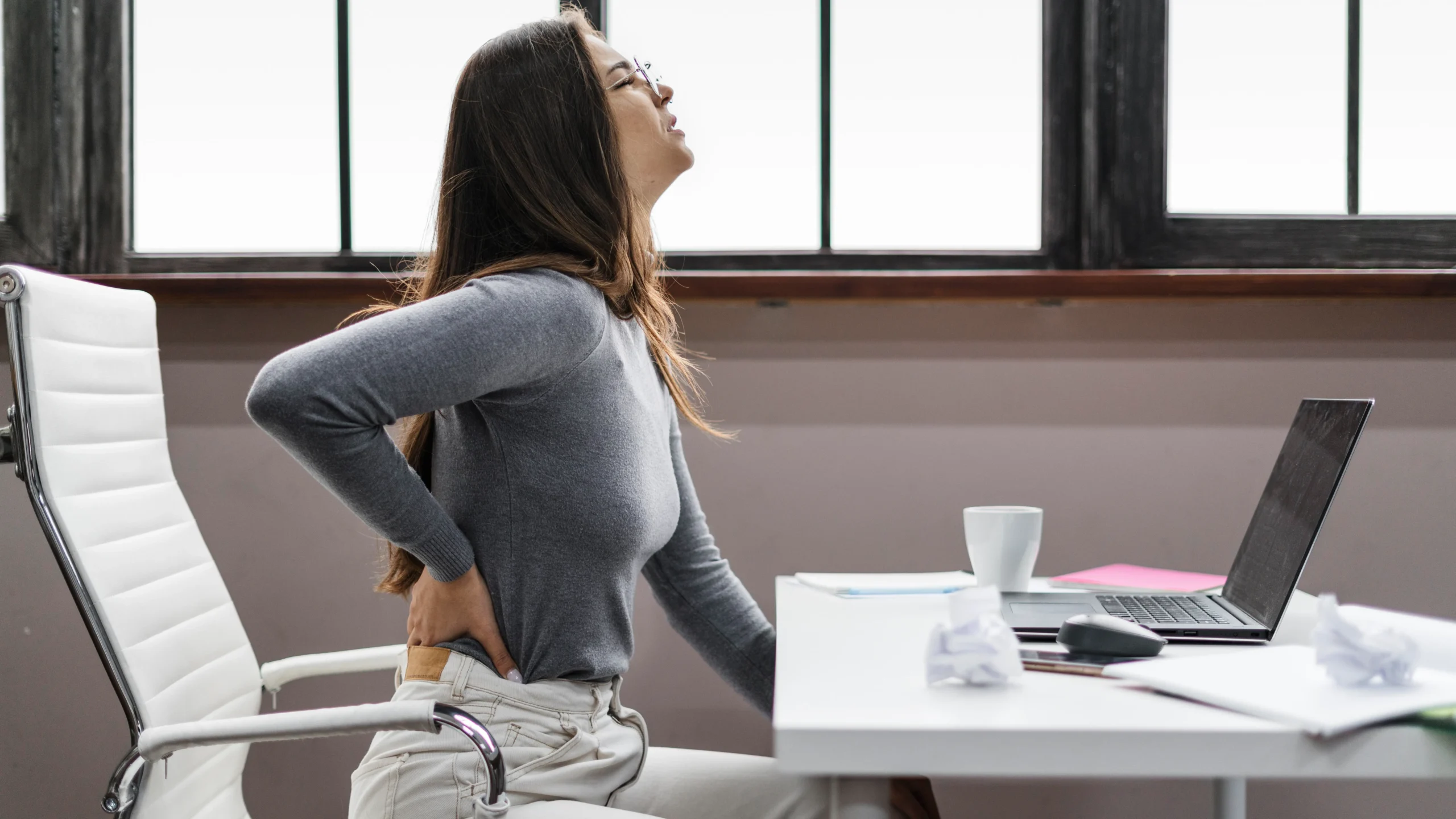
Why Does Sitting for Long Hours Cause Hip Pain?
The hip joint is designed for movement — prolonged static postures place it under sustained compressive and tensile loads it is not built to tolerate indefinitely. Several mechanisms contribute:- Hip flexor shortening: The iliopsoas and rectus femoris muscles remain in a shortened position throughout sitting, becoming progressively tighter and pulling on their attachments
- Gluteal inhibition: The gluteus medius and maximus switch off during sitting, altering load distribution across the hip and pelvis
- Ischial compression: Sustained pressure on the sitting bones and surrounding soft tissues causes localised pain and bursitis
- Reduced joint lubrication: Synovial fluid is distributed through movement; static postures impair this process, increasing friction in arthritic joints
6 Common Causes of Hip Pain After Sitting
1. Hip Flexor Tightness and Strain
The most common cause in desk workers and office-based professionals. After hours of sitting, the hip flexors — particularly the iliopsoas — become shortened and overactive. On standing, they pull on the lumbar spine and hip, causing anterior (front) hip pain and stiffness that typically eases after a few minutes of walking. Aggravated by poor chair height, forward-leaning posture, and insufficient movement breaks.2. Piriformis Syndrome
The piriformis muscle sits deep in the buttock and can compress the sciatic nerve when tight or inflamed — a condition known as piriformis syndrome. Prolonged sitting on hard surfaces or with crossed legs is a common trigger. Pain is felt deep in the buttock and may radiate down the back of the thigh, mimicking sciatica. It is typically worse when sitting and improves with walking or lying flat.3. Hip Osteoarthritis
Hip osteoarthritis causes cartilage degeneration within the hip joint, leading to groin pain and stiffness that is characteristically worse after prolonged rest or sitting and eases with gentle movement — before worsening again with sustained activity. The pain often refers to the inner knee, which can confuse both patients and clinicians. For a broader overview, see our guide on knee arthritis treatment which also covers the relationship between hip and knee pathology.4. Trochanteric (Hip) Bursitis
Inflammation of the bursa over the greater trochanter (the bony prominence on the outer hip) causes lateral hip pain that is worsened by sitting with crossed legs, lying on the affected side, or pressure from a car seat. It is particularly common in women in middle age and is often misdiagnosed as 'hip arthritis'. The joint itself is normal on X-ray; the pain comes from the soft tissue overlying it.5. Sacroiliac Joint Dysfunction
The sacroiliac (SI) joint connects the spine to the pelvis and is a frequently overlooked source of buttock and posterior hip pain. Sitting for long periods — particularly in an asymmetric or twisted posture — increases SI joint stress. Pain is typically felt in the lower back, buttock, and posterior hip, and is often confused with lumbar disc disease or sciatica.6. Referred Pain from the Lumbar Spine
L2, L3, and L4 nerve root irritation from lumbar disc herniation or facet joint disease can refer pain to the anterior thigh, groin, and hip — all worsened by the sustained spinal flexion of sitting. This is a true referred pain pattern — the hip joint itself is normal, but it hurts because of the spinal source. A thorough clinical examination and, where necessary, MRI of the lumbar spine are essential to identify this pattern and avoid misdiagnosis.5 Effective Stretches for Hip Pain After Sitting
These stretches target the most commonly affected structures. Hold each for 30 seconds, repeat 2–3 times, and perform at least once every 2 hours during prolonged sitting.| Stretch | Target Structure | How to Perform |
| 1. Hip Flexor Lunge Stretch | Iliopsoas, rectus femoris | Kneel on one knee (affected side back). Shift weight forward until a stretch is felt at the front of the rear hip. Keep the torso upright. Hold 30 sec each side. |
| 2. Piriformis Figure-Four Stretch | Piriformis, external hip rotators | Lie on your back. Cross the ankle of the affected leg over the opposite knee. Gently pull the lower leg towards your chest until a deep buttock stretch is felt. Hold 30 sec. |
| 3. Supine Knee-to-Chest Stretch | Hip flexors, lumbar extensors | Lie on your back. Pull one knee gently to your chest with both hands. Keep the opposite leg flat on the floor. Hold 30 sec each side. |
| 4. Seated Hip Opening Stretch | Hip external rotators | Sit upright on a chair. Place the ankle of one foot on the opposite knee. Gently press the raised knee downward until a stretch is felt in the outer hip. Hold 30 sec. |
| 5. 90-90 Hip Stretch | Hip flexors and rotators simultaneously | Sit on the floor with both hips at 90 degrees — front leg forward, rear leg to the side. Sit tall and lean slightly forward over the front shin. Hold 30 sec each side. |
Treatment Options for Hip Pain After Sitting
Conservative Management
- Frequent movement breaks — stand and walk for 2–3 minutes every 30–45 minutes of sitting
- Ergonomic chair adjustment — hips and knees at 90 degrees, feet flat on the floor, lumbar support
- Physiotherapy — targeted hip flexor stretching, gluteal activation, core stabilisation, and gait retraining
- Anti-inflammatory medications — NSAIDs for acute flare-ups; topical gels for localised bursitis
- Nutrition and weight management — reducing systemic inflammation and joint load; see our guide on nutrition for joint health
Injection Therapies
- Corticosteroid injection — highly effective for trochanteric bursitis and SI joint dysfunction
- Image-guided injection — ultrasound or fluoroscopy-guided injection for precise delivery in deep structures
- PRP therapy — considered for early hip osteoarthritis and tendinopathy where structural preservation is the goal
Surgical Options
Surgery for hip pain from sitting is rarely required as a first-line measure. Where hip osteoarthritis has progressed to the point of causing constant pain that limits daily life despite conservative care, joint replacement surgery may be appropriate. For younger patients with focal cartilage damage, cartilage repair procedures offer a joint-preserving alternative. All surgical decisions are made only after a thorough evaluation and failure of appropriate conservative treatment at Happy Knees, Malad East.When Should You See an Orthopaedic Doctor?
Most hip pain from sitting resolves with stretching, ergonomic changes, and physiotherapy. Seek professional evaluation from our joint pain specialists in Malad if you experience:- Pain that persists for more than 4–6 weeks despite stretching and activity modification
- Severe restriction of hip range of motion — difficulty putting on shoes or socks
- Groin pain that radiates to the inner knee (possible hip OA or referred pain)
- Hip pain accompanied by lower back pain, leg weakness, or numbness (possible spinal cause)
- Night pain that disrupts sleep
- Clicking, locking, or a sensation of the hip giving way
Frequently Asked Questions
Q1. Why does my hip hurt after sitting for a long time?
Prolonged sitting shortens hip flexors, compresses the hip joint, and deactivates the glutes. Common causes include hip flexor tightness, piriformis syndrome, bursitis, hip osteoarthritis, and referred pain from the lumbar spine.Q2. Which stretches help most for hip pain after sitting?
The hip flexor lunge stretch, piriformis figure-four stretch, supine knee-to-chest, seated hip opener, and the 90-90 stretch. See the table above for step-by-step instructions.Q3. Is hip pain from sitting serious?
Most cases are due to muscle tightness or bursitis and respond well to stretching and physiotherapy. Persistent pain beyond 4–6 weeks, groin pain, or restricted hip movement warrant an orthopaedic evaluation.Q4. Can hip pain after sitting cause knee pain?
Yes. Hip osteoarthritis commonly refers pain to the inner knee and thigh. If your knee pain has no clear local cause, hip assessment is an essential part of the evaluation.Q5. How can I prevent hip pain from sitting at a desk?
Take a 2–3 minute movement break every 30–45 minutes, adjust your chair so hips and knees are at 90 degrees, perform daily hip flexor stretches, and strengthen your glutes with targeted exercises.Q6. Can hip pain from sitting be treated without surgery?
Yes — the vast majority of cases respond to physiotherapy, ergonomic correction, stretching, and if needed, injection therapy. Surgery is a last resort for cases involving advanced structural joint disease.Why Choose Us?
At Happy Knees Orthopaedic Clinic, we provide expert, compassionate care to help you move pain-free and improve your quality of life. Specializing in knee and joint treatments, we combine advanced technology with experienced orthopedic expertise to deliver accurate diagnosis and personalized treatment plans. With a strong focus on patient comfort, clear communication, and evidence-based care in a professional, welcoming environment, your joint health is always our priority. To book a consultation, contact 08341535353 or visit https://happyknees.in/References & Citations
- Reiman MP, et al. Hip osteoarthritis: what the orthopaedic physical therapist needs to know. Phys Ther Sport. 2009;10(4):144–152.
- Boyajian-O'Neill LA, et al. Diagnosis and management of piriformis syndrome. J Am Osteopath Assoc. 2008;108(11):657–664.
- NICE. Hip fracture: management. Clinical Guideline CG124. Updated 2023.
- Grimaldi A, et al. Gluteal tendinopathy: a review of mechanisms, assessment and management. Sports Med. 2015;45(8):1107–1119.
- Colasanti CA, et al. Sacroiliac joint disorders: a review of diagnosis and treatment. JBJS Rev. 2023;11(3).