
What Is the ACL and Why Does It Matter?
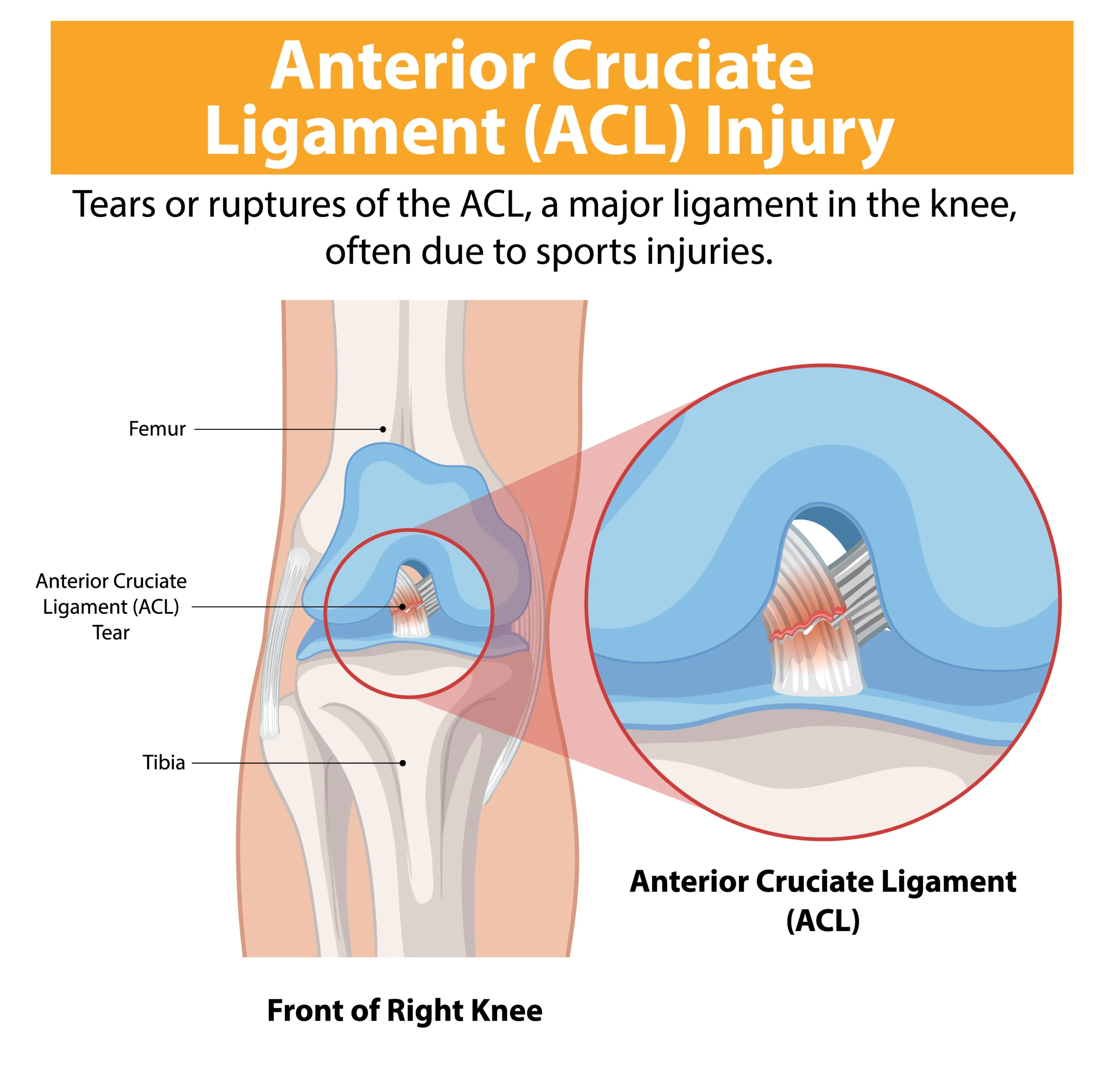
The anterior cruciate ligament runs diagonally through the centre of the knee, connecting the femur (thigh bone) to the tibia (shin bone). Its primary role is to control rotational stability and forward movement of the tibia. Without an intact ACL, the knee can give way unpredictably — particularly during pivoting, cutting, or jumping movements. It is also commonly injured alongside the meniscus; for more on how these injuries relate, see our guide on types of knee pain.What Causes an ACL Injury?
ACL injuries are predominantly non-contact — meaning most occur without a direct blow to the knee. Common mechanisms include:- Sudden deceleration followed by a change of direction (cutting movements)
- Pivoting or twisting on a planted foot
- Landing awkwardly from a jump with the knee straight or inward
- Direct collision — common in contact sports such as football and rugby
ACL Injury Symptoms: What to Look For
The symptoms of an ACL tear are usually dramatic and immediate. Key signs include:- Audible 'pop': Many patients report hearing or feeling a distinct pop at the moment of injury
- Immediate severe pain: Sharp pain that may ease quickly, even if the injury is serious
- Rapid swelling: Haemarthrosis (blood in the joint) causes significant swelling within 2–6 hours
- Knee instability: A feeling that the knee is giving way or cannot be trusted
- Restricted range of motion: Difficulty fully bending or straightening the knee
- Inability to bear weight: Particularly in the immediate aftermath of the injury
How Is an ACL Injury Diagnosed?
Diagnosis involves a combination of clinical examination and imaging:- Lachman test & anterior drawer test: Clinical tests to assess ACL integrity — highly reliable in experienced hands
- X-ray: Rules out associated bony injuries or avulsion fractures
- MRI: Gold-standard for confirming the diagnosis, grading the tear, and identifying concurrent injuries (meniscus, MCL, cartilage)
ACL Injury Treatment Options
Treatment depends on the grade of tear, the patient's age, activity level, and whether the knee is functionally stable.Non-Surgical Management
Not all ACL injuries require surgery. Conservative management may be appropriate for:- Partial tears (Grade I–II) in older or less active patients
- Patients who do not participate in pivoting or cutting sports
- Cases where the knee remains functionally stable after rehabilitation
Surgical Management — ACL Reconstruction
For complete ACL tears — especially in young, active, or sporting patients — ACL reconstruction surgery is the recommended treatment. At Happy Knees, Dr Saraogi performs arthroscopic ligament reconstruction using minimally invasive techniques. The torn ligament is replaced with a graft — most commonly the hamstring tendon (gracilis and semitendinosus) or the patellar tendon. The procedure is performed under arthroscopic guidance through small keyhole incisions, minimising soft tissue disruption and allowing faster recovery. Associated injuries — such as meniscal tears or cartilage damage — are addressed at the same time. Where cartilage damage is also present, cartilage repair procedures may be performed alongside reconstruction during the same knee arthroscopy session.ACL Recovery Time: What to Expect
Recovery after ACL reconstruction follows a structured, phased rehabilitation programme. Returning to sport too early is the leading cause of re-injury — a risk that must be taken seriously.|
Phase |
Timeframe | Milestones |
|
Early recovery |
Weeks 1–2 |
Pain & swelling control, walking without crutches, early range-of-motion exercises |
| Strength building | Weeks 3–8 |
Quadriceps & hamstring strengthening, stationary cycling, proprioception training |
|
Functional rehab |
Months 2–4 | Jogging, straight-line running, sport-specific drills begin |
| Return to sport | Months 4–6 |
Non-contact sport return; ongoing strength & agility work |
|
Full return |
Months 9–12 |
Contact & pivoting sport return — guided by objective testing, not time alone |
When Should You See a Doctor?
If you have suffered a knee injury with any of the following, seek orthopaedic evaluation promptly:- An audible pop followed by rapid swelling
- Feeling that the knee is unstable or giving way
- Inability to return to sport after 2–3 weeks of rest
- Knee locking or catching during movement
Frequently Asked Questions
Q1. What are the main symptoms of an ACL injury?
A sudden pop, immediate pain, rapid swelling within hours, knee instability, and difficulty bearing weight are the classic signs.Q2. Can an ACL tear heal without surgery?
Partial tears in less active patients can be managed conservatively. Complete tears in active or sporting individuals generally require surgical reconstruction for long-term stability.Q3. How long does ACL recovery take?
Daily activities: 6–8 weeks. Non-contact sport: 4–6 months. Full return to contact or pivoting sport: 9–12 months.Q4. What graft is used in ACL reconstruction?
The most common options are the hamstring tendon (gracilis and semitendinosus) and the patellar tendon. Dr Saraogi will recommend the most suitable graft based on your anatomy and sport demands.Q5. Is ACL surgery done arthroscopically?
Yes. At Happy Knees, ACL reconstruction is performed entirely arthroscopically — using small keyhole incisions, which means less scarring, less blood loss, and faster recovery compared to open surgery.Q6. Can I prevent an ACL injury?
Neuromuscular training programmes — including landing technique, hip strengthening, and agility drills — have been shown to reduce ACL injury risk by up to 50% in high-risk athletes.Why Choose Us?
At Happy Knees Orthopaedic Clinic, we provide expert, compassionate care to help you move pain-free and improve your quality of life. Specializing in knee and joint treatments, we combine advanced technology with experienced orthopedic expertise to deliver accurate diagnosis and personalized treatment plans. With a strong focus on patient comfort, clear communication, and evidence-based care in a professional, welcoming environment, your joint health is always our priority. To book a consultation, contact 08341535353 or visit https://happyknees.in/References & Citations
- NICE. ACL injuries — pathway and management. NHS Evidence. 2023.
- AAOS. Anterior Cruciate Ligament (ACL) Injuries — OrthoInfo. 2022.
- Meierbachtol A, et al. Quantitative improvements in hop test scores after a 10-week neuromuscular training program. Sports Health. 2017;9(1):10–17.
- Monk AP, et al. Surgical versus conservative interventions for treating ACL injuries. Cochrane Database Syst Rev. 2016;4:CD011166.
- Grindem H, et al. Simple decision rules can reduce re-injury risk after ACL reconstruction. Br J Sports Med. 2016;50(13):804–808.